
|
|
Dit artikel hoort bij het verhaal Nick Cave interpreteert zijn favorieten op Kicking Against The Pricks. |
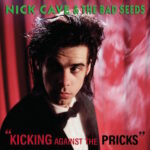
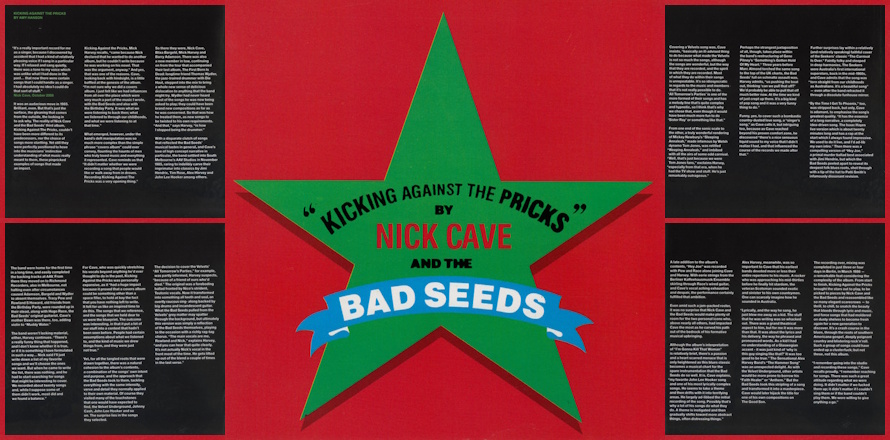
Liner notes
In 2009 werd Nick Cave & The Bad Seeds’ Kicking Against The Pricks opnieuw uitgebracht. De uitgave bevatte, naast extra muziek, liner notes in de vorm van een essay. Deze wordt hieronder integraal weergegeven.
KICKING AGAINST THE PRICKS
BY AMY HANSON
“It’s a really important record for me as a singer, because I discovered by accident that I had a kind of relatively pleasing voice if I sang in a particular way. If I relaxed and sang quietly, there was a tone to my voice which was unlike what I had done in the past… that now there were certain songs that I could handle as a singer. I had absolutely no idea that I could do that sort of stuff.”
Nick Cave, October 2008It was an audacious move in 1985. Brilliant, even. But that’s just the surface, the gleaning that comes from the outside, the looking in to ask why. The reality of Nick Cave and the Bad Seeds’ third album, Kicking Against The Pricks, couldn’t have been more different to its predecessors, nor the choice of the songs more startling. Yet still they were perfectly positioned to hove into the musicians’ instinctive understanding of what music really meant to them, these pinpricked examples of songs that made an impact.
Kicking Against The Pricks, Mick Harvey recalls, “came because Nick declared that he wanted to do another album, but he couldn’t write because he was working on his novel. That was the argument, anyway.” And yes, that was one of the reasons. Cave, looking back with hindsight, is a little baffled at the genesis of the album. “I’m not sure why we did a covers album. I just felt like we had influences from all over the place which were very much a part of the music I wrote, with the Bad Seeds and also with the Birthday Party. It was what we were listening to back then; what we listened to through our childhoods, and what we were listening to at that time.”
What emerged, however, under the band’s deft manipulation was so much more complex than the simple phrase “covers album” could ever convey, flaunting the haunts of men who truly loved music and everything it represented. Cave reminds us that “It didn’t matter whether we were recording a song that that people would like or walk away from in droves. Recording Kicking Against The Pricks was a very opening thing.”
So there they were, Nick Cave, Blixa Bargeld, Mick Harvey and Barry Adamson. There was also a new member in tow, continuing on from the tour that accompanied their last album, The First Born Is Dead: longtime friend Thomas Wydler, the jazz-trained drummer with Die Haut, stepped into the mix to bring a whole new sense of delicious dislocation to anything that the band might try. Wydler had never heard most of the songs he was now being asked to play; they could have been brand new compositions as far as he was concerned. So that was how he treated them, as new songs to be twisted to his own requirements. “And that,” says Harvey, “is how I stopped being the drummer.”
With a disparate clutch of songs that reflected the Bad Seeds’ musical tastes in general, and Cave’s love of high concept narrative in particular, the band settled into South Melbourne’s AAV Studios in November 1985, raring to indelibly carve their imprimatur by Jimi Hendrix, Tim Rose, Alex Harvey and John Lee Hooker among others.
The band were home for the first time in a long time, and easily completed the backing tracks at AAV. From there they moved on to Richmond Recorders, also in Melbourne, not halting even after circumstances caused Adamson, Bargeld and Wydler to absent themselves. Tracy Pew and Rowland S Howard, old friends from the Birthday Party, were rounded up in their stead, along with Hugo Race, the Bad Seeds’ original guitarist. Cave’s mother Dawn was there, too, adding violin to “Muddy Water.”
The band weren’t lacking material, either, Harvey continues, “There’s a really funny thing that happened, and I don’t know whether it is true, or if it is something I have formulated in such a way… Nick said I’ll just write down a list of my favorite songs and we’ll choose the ones we want. But when he came to write the list, there was nothing, and he had to start searching for songs that might be interesting to cover. We recorded about twenty songs and, while I suppose some of them didn’t work, most did and we found a balance.”
For Cave, who was quickly stretching his vocals beyond anything he’d ever thought to do in the past, Kicking Against The Pricks was personally expansive, as it “had a huge impact because it proved that a covers album could be something other than a space filler, to hold at bay the fact that you have nothing left to write. It felt for us like an inspired time to do this. The songs that we reference, and the songs that we held dear to us were the blueprint. The outcome was interesting, in that it put a lot of our stuff into a context that hadn’t been seen before. People had certain assumptions about what we listened to, and the kind of music we drew things from, and they were just not true.”
Yet, for all the tangled roots that were drawn together, there was a natural cohesion to the album’s contents, a combination of the songs’ own intent and purpose, and the approach that the Bad Seeds took to them, tackling everything with the same intensity, verve and detail they normally applied to their own material. Of course they visited many of the touchstones that one would have expected to find, the Velvet Underground, Johnny Cash, John Lee Hooker and so on. The surprise lies in the songs they selected.
The decision to cover the Velvets’ “All Tomorrow’s Parties,” for example, was party informed, Harvey suspects, “because of a friend of ours who’d died.” The original was a foreboding ballad fronted by Nico’s strident, Teutonic vocals. Now it transformed into something all teeth and soul, an overtly raucus sing-along song backed by big drums and incandescent guitar. What the Bad Seeds pulled from the Velvets’ grey matter may spatter through the background, but ultimately this version was simply a reflection of the Bad Seeds themselves, playing to the occasion with a richly rag-tag chorus. “The main vocals are me, Rowland and Nick,” explains Harvey, “and you can hear that quite clearly. It’s not actually Nick’s vocal in the front most of the time. He gets lifted up out of the blend a couple of times in the last verse.”
Covering a Velvets song was, Cave insists, “basically an ill-advised thing to do because what made the Velvets is not so much the songs, although the songs are wonderful, but the way that they are recorded, and the spirt in which they are recorded. Most of what they do within their songs is unrepeatable. It’s so idiosyncratic in regards to the music and members that it’s not really possible to do. ‘All Tomorrow’s Parties’ is one of the more formed of their songs and has a melody line that’s quite complex and hypnotic, so I think that’s why we chose that, even though it would have been much more fun to do ‘Sister Ray’ or something like that.”
From one end on the sonic scale to the other, a truly wonderful rendering of Mickey Newbury’s “Sleeping Annaleah,” made infamous by Welsh dynamo Tom Jones, was retitled “Weeping Annaleah,” and imbibed with all the airs of some odd carnival. “Well, that’s just because we were Tom Jones fans,” exclaims Harvey, “especially from that era, when he had the TV show and stuff. He’s just remarkably outrageous.”
Perhaps the strangest juxtaposition of all, though, takes place within the band’s restructuring of Gene Pitney’s “Something’s Gotten Hold Of My Heart.” Three years before Marc Almond torched the same song to the top of the UK charts, the Bad Seeds’ full on schmaltz assault was, Harvey admits, “us pushing the boat out, thinking ‘can we pull that off?’ We’d probably be able to pull that off much better now. At the time we kind of just crept up there, It’s a big kind of pop song and it was a very funny thing to do.”
Funny, yes, to cover such a bombastic country-dusted love song, a “singer’s song,” as Cave calls it, but intriguing too, because as Cave reached beyond his proven comfort zone, he discovered “there’s a nice sensuous liquid sound to my voice that I didn’t realize I had, and that influenced the course of the records we made after that.”
Further surprises lay within a relatively (and relatively speaking) faithful cover of the Seekers’ classic “The Carnival Is Over.” Faintly folky and steeped in deep harmonies, The Seekers were Australia’s first international superstars, back in the mid-1960s, and Cave admits that the song was “torn straight from out childhoods as Australians. It’s a beautiful song” – even after the band refracted it through a dissolute funhouse mirror.
“By The Time I Get To Phoenix,” too, was stripped back, but only, Cave is adamant, to emphasise the song’s greatest quality. “It has the essence of a long narrative, a completely idea-driven song. The Isaac Hayes live version which is about twenty minutes long and has a rap at the start which I always found impressive. We used to do it live, and I’d ad-lib my own intro.” Then there was a compelling version of “Hey Joe,” a primal murder ballad best associated with Jimi Hendrix, but which the Bad Seeds peeled apart to reveal its deepest folk blues roots, shot through with a tip of the hat to Patti Smith’s infamously dissonant revision.
A late addition to the album’s contents, “Hey Joe” was recorded with Pew and Race alone joining Cave and Harvey. With eerie strings from the Berliner Kaffeehausmusik Ensemble skirling through Race’s wired guitar, and Cave’s vocal aching exhaustion and despair, the performance certainly fulfilled that ambition.
Even amid such a jam-packed roster, it was no surprise that Nick Cave and the Bad Seeds would make plenty of room for the two personal icons who, above nearly all others, had impacted Cave the most as he carved his path out of the bedrock of his formative musical upbringing.
Although the album’s interpretation or “I’m Gonna Kill That Woman” is relatively brief, there’s a passion and a heart scarred menace that is only heightened as this blues classic becomes a musical chart for the spare instrumentation that the Bad Seeds do so well. It is, Cave explains, “my favorite John Lee Hooker song and one of his most lyrically complex songs. He seems to take a theme and then drifts with it into terrifying areas. He largely ad-libbed the initial recording of the song. Possibly that’s why a lot of his songs do what they do. A theme is instigated and then gradually shifts toward more abstract things, often distressing things.”
Alex Harvey, meanwhile, was so important to Cave that his earliest bands devoted more or less their entire repertoire to his music. A rocker who was approaching his mid-thirties before he finally hit stardom, the veteran Scotsman sounded exotic and sinister to his own countrymen. One can scarcely imagine how he sounded in Australia.
“Lyrically, and the way he sang, he just blew me away as a kid. The stuff that he was writing was so whacked out. There was a grand theatrical aspect to him, but for me it was more than that. It was about the lyrics and his delivery, the way he phrased and pronounced words. As a kid I had no understanding of a Glaswegian accent – it was just kind of ‘why is this guy singing like that?’ It was too good to be true.” The Sensational Alex Harvey Band’s “The Hammer Song” was an unexpected delight. As with the Velvet Underground, other artists would be more prone to borrow his “Faith Healer” or “Anthem.” But the Bad Seeds took this stripling of a song and transformed it into a masterpiece. Cave would later hijack the title for one of his own compositions on The Good Son.
The recording over, mixing was completed in just three or four days in Berlin, in March 1986 – a remarkable feat considering the complexity of the album. From start to finish, Kicking Against The Pricks brought the stars out to play, to be picked to pieces by Nick Cave and the Bad Seeds and reassembled like so many elegant scarecrows – to thrill, to chill, to snatch the beauty that bleeds through lyric and music, and force songs that had moldered on dusty shelves to become fresh again for a new generation to discover. It’s a crash course in the blues, through the roots of southern Americana gospel, deeply poignant country and blistering rock’n’roll. Such a group of songs could have ended up a clusterfuck; but not these, not on this album.
“I remember going into the studio and recording these songs,” Cave recalls proudly. “I remember reaching for songs. There was such a great attitude regarding what we were doing. It didn’t matter if we fucked them up; it didn’t matter if I couldn’t sing them or if the band couldn’t play them. We were willing to give anything a go.”

